


G3.3.3 High-Efficiency Air-Side System Simulator
For decades, HVAC projects in China focused on basic heating and cooling. Today, premium offices, hotel public areas and high-end residences demand more: stable 40%–60% humidity, sufficient fresh air for high occupancy, operation without central heating/cooling plants in mild seasons, and fully automated control without manual intervention.
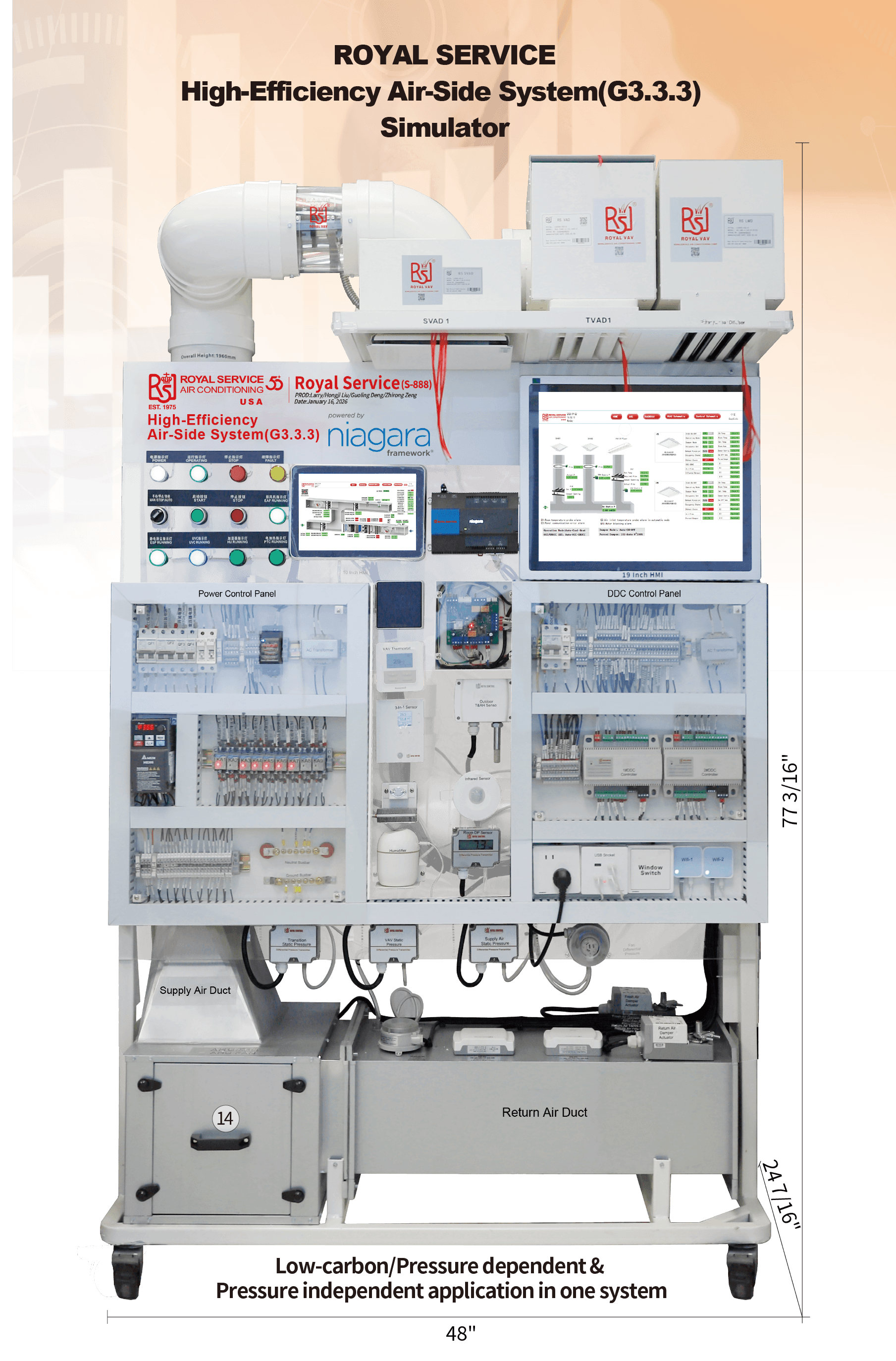
Founded in Los Angeles in 1975 and entering China in 1995, Royal Service specializes in VAV terminals and integrated HVAC solutions. Drawing on over 50 years of VAV expertise, the G3.3.3 High-Efficiency Air-Side System Simulator transforms engineering experience into a complete air-side control system and compact training/demo platform replicating real-world operating conditions.
More than an AHU and ductwork assembly, it integrates VFD supply air control, VAV airflow matching, adaptive fresh/return air ratios, temperature/humidity valve control, dehumidification/humidification, indoor micro-positive pressure, automatic mode switching, and pre-cooling/pre-heating. Equipped with Royal Service SVAD smart diffusers, VAV terminals, DDC controls, a touchscreen HMI, and CO₂, temperature, humidity and static pressure sensors, it integrates the AHU, terminals and controls into one complete system.
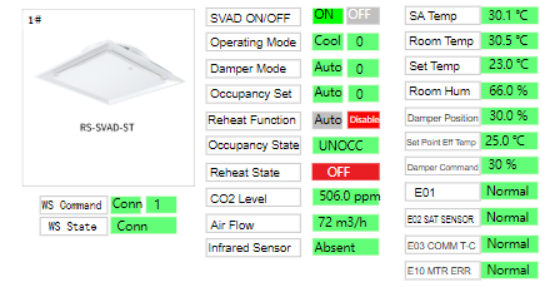
A touchscreen HMI supports Wi-Fi connectivity with tablets and the Royal Service APP for remote monitoring and interaction. Simply operate the touchscreen or thermostat to observe real-time responses:
✅ VAV Terminal Response: SVAD air volume adjusts in real time to thermostat commands, with linear diffuser supply status synchronized;
✅ Coordinated VFD control: AHU fan speed automatically adjusts to duct static pressure and terminal load;
✅ Environmental Simulation: Humidifiers, electric heaters and sensors dynamically simulate temperature, humidity and CO2 changes, demonstrating adaptive control.
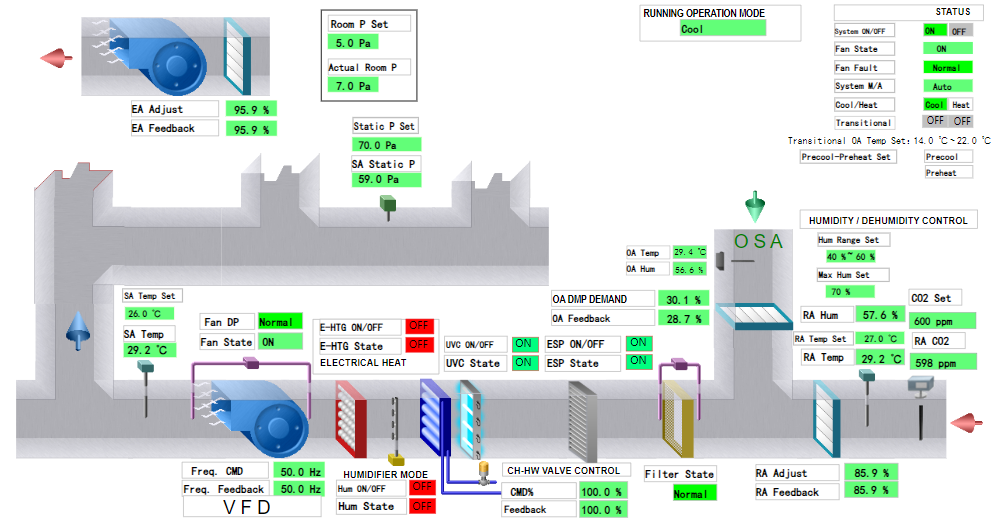
Core Control Logic:
1. Fan VFD · Constant Static Pressure: Monitors main supply duct pressure in real time and adjusts fan frequency to maintain stable terminal airflow.
2. CO₂-Based Fresh Air, 2:1 Inverse Linkage: Under normal cooling/heating, the fresh air damper modulates with return air CO₂. When fully open, the return air damper is ~50%, increasing fresh air with occupancy while saving heating/cooling energy at lower occupancy.
3. Cooling: Precisely modulates the chilled water valve to stabilize supply air temperature and avoid frequent full-load plant operation.
4. Heating: Prioritizes hot water heating; electric heat supplements when capacity is insufficient and indoor temperature deviation reaches ≥1°C, preventing temperature fluctuations.
5. Cooling & Dehumidification: When return air RH exceeds the upper limit, fully opens the chilled water valve and minimizes fresh air. If supply air falls >3°C below setpoint, electric reheat activates for independent temperature and humidity control.
6. Heating & Humidification: Opens the humidification water valve when return air RH falls below the lower limit, preventing winter dryness and static electricity.
7. Transition Season - Full Fresh Air (14–22℃): Fresh air damper fully opens; return air damper closes, utilizing free cooling to reduce plant loads.
8. Indoor Micro-Positive Pressure: Fine-tunes the exhaust damper to prevent corridor odors, kitchen fumes and garage exhaust from entering.
9. Pre-Cooling: Prioritizes fresh air cooling; the fan runs at full frequency and the chilled water valve opens fully to rapidly lower indoor temperature before automatic return to normal mode.
10. Pre-Heating: Fresh air damper closes; hot water valve fully opens for rapid start-up heating and improved efficiency.
Core Value of G3.3.3: It condenses over 50 years of Royal Service VAV expertise into an integrated air-side simulator for intuitive demonstration, on-site commissioning and real-world application—making complex VAV control strategies visible and tangible.

